Anxiety and Depression
Bob Rich’s Self-Therapy Guide: Equanimity
In this series, Dr. Bob Rich teaches you how to leave behind depression, anxiety, and other forms of suffering all too common in our crazy world. Recovering the Self published three sections of Bob Rich’s book From Depression to Contentment: A self-therapy guide in a series of posts – the first section ending with the quest for meaning and the second section concluding with The Development of Resilience.
The third section of Bob’s work was marked by special attention to various techniques and practices that are helpful in controlling depression. It concluded with a discussion on values and their implication in therapy. Bob now shares the final section of his self-therapy guide that delves deeper into the practical side of his therapy work illustrating with examples from individual cases of his own patients.
The last part covered the story of someone who had more than one life on this planet. Here, Bob discusses equanimity through acceptance.
Dealing with Severe Physical or Emotional Pain

I’ve said previously, my major reason for bouts of sadness is for the coming environmental catastrophe that will kill billions of humans and other creatures, and probably result in the extinction of all complex life on earth. I am a professional grandfather: love children and want them to have a good life, knowing they won’t.
The tool I use every day, for this issue and for a great many lesser ones, is “equanimity” or acceptance. I’ve left it till last, because it’s the most powerful tool there is.
Jon Kabatt-Zinn’s technique for coping with severe, chronic physical pain is to calmly observe it, and allow it to be there. This works just as well for emotional pain. Here is a card I used to give to my clients:
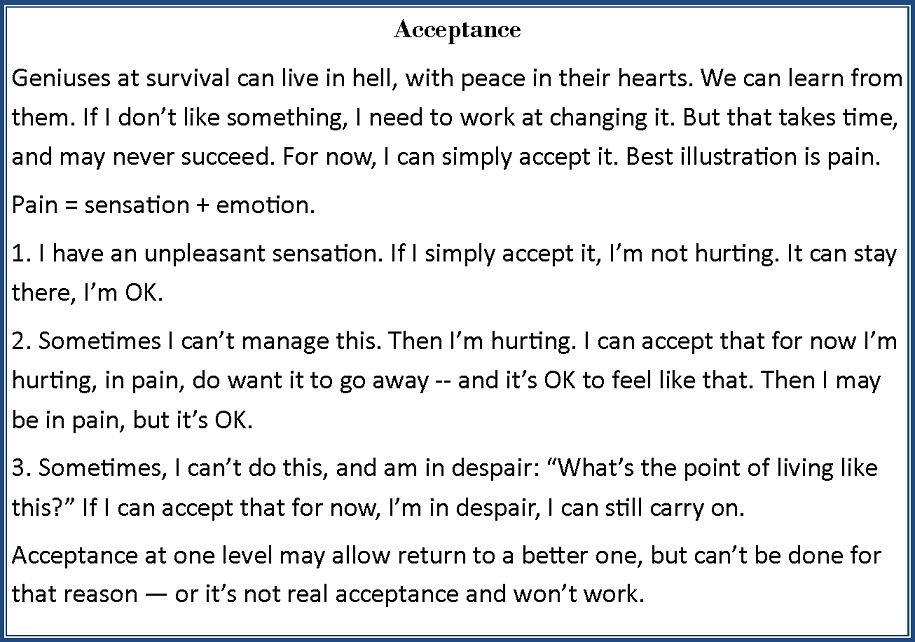 OK, so I am told that a friend has just had a baby. I get the instant pain of knowing that this new person will grow older in a world of horror. That horror is active, right now, in other parts of earth, but we in the so-far lucky places are due for it, soon. So, I drop into advance grieving for this child.
Then I remember: the past is history, the future a mystery; I give you a PRESENT. I may be wrong (wouldn’t that be wonderful!) and the horror may never come. Besides, my thought is only real if I buy into it. It’s a thought, and an emotional reaction to the thought. If I can simply accept the thought, acknowledge its presence, allow it to be there, then the suffering goes, and I can smilingly congratulate the parents.
If on a particular occasion I can’t get rid of the pain, then I can acknowledge that I feel it, and it’s OK to feel it. I can feel the pain, and share the parents’ joy at the same time.
And if I have really slipped into the black hole of anticipatory grief for this tiny newcomer, then I can accept that. I can still put a smile on my face, one of genuine metta, and congratulate the new parents.
It’s even worse, of course, when I think of my own loved ones. And yet, perhaps 90% of the time, I am fine. I do live a life of contentment. When I slip, I simply accept that, for now, I have slipped, and this, too, shall pass. It does, and I slip up into contentment again. It’s not a race, not a performance I need to measure or struggle with. What is, is, for now.
Writing fiction is one of my joys, one way I can enter the state of “flow.” (Mind you, I’m in flow right now, as I write.) A huge benefit is the people I invent. I learn from them all the time.
Bill Sutcliffe is one of my teachers. He is the “Doom Healer,” whose task is to eliminate all evil on Earth. The hero of a science fiction series, right now he only exists in my computer, but I’ll publish his story one day. In the meantime, he helps to keep me sane in a crazy world. As a fifteen-year-old boy, he made a speech that featured on the world stage. Here is an extract:
In preparation for today, I studied past talks here, and wrote a similar speech. Like the others, it’s full of information, dense — and boring. I’ve posted that speech to my website, with references, and will instead just talk to you. My excuse is, after all, I’m only a kid.
First we need to deal with the horror of what’s coming. As George said, climate change will kill billions. We’re past the tipping points.
We arrogant humans have looked on this planet as the only seat of intelligent life. It isn’t. Merlin, the alien the recent solar flare killed, told me there are millions of locations of intelligent life within our galaxy alone, and there are innumerable galaxies. All those places, including Earth, are schools for souls. The body dies, but the life energy of an animal or a plant continues. There is sound scientific evidence for reincarnation.
So, those billions will return, if not here, then to some other school within the universe. This is because we have a job to do. Merlin told me, we need to live again and again, learning and advancing, until we have evolved sufficiently. You’re not here to become wealthy, or famous, or powerful. You’re here on a journey toward becoming like Jesus, like the Buddha. This is not a matter of religion. You can be an atheist, but if you attain a life dedicated to Love, what we call by the Buddhist term metta, then you qualify for Buddhahood.
Everything ever born must die. We can die one at a time, or billions together. That doesn’t matter. We can die before birth, or 100 years old. That doesn’t matter. Even suffering is only short term. In the long view, we can shrug that off. All that matters is progress along the journey toward moral perfection.
I hope I’ve eased your pain.
You can read the document on his website.
It actually isn’t boring. People who have read it responded with compliments (to me, not to Bill, because they don’t understand that reality lives in my computer).
Does equanimity always work? Bill Sutcliffe taught me another story about that: “This Buddhist abbot was famous for his equanimity. Then robbers attacked the monastery and were slaughtering his monks. He kept screaming and crying. His deputy said, ‘But Father, what about equanimity?’ The abbot answered, ‘Equanimity is all very well, but they’re KILLING MY PEOPLE’!”
If even the abbot could forget the deepest level of equanimity, then us lesser-trained mortals can be excused when we do so. You don’t need to be perfect, only to do your best.
Dealing with Success and Failure
This logic can be applied to absolutely anything. Suppose you are training for a contest. Sonja Lyuobomirsky’s research shows that you’ll get the most emotional benefit out of the total experience by aiming for the sky before the event, but accepting whatever the outcome is, once it is over. This is equanimity.
Similarly, she says, when something positive happens in your life, smilingly accept it with gratitude, but have minimal expectations for its benefit. That way, you’re less likely to be disappointed, and more likely to get a pleasant surprise. When there is a negative change, simply accept it, seek solutions, but accept frustration if these attempts are unsuccessful. Strive to do the best you can, and be content with the outcome.
Homework
Especially if you have severe, chronic pain, but even if you don’t, do Jon Kabat-Zinn’s Mindfulness-Based Stress Reduction course. If you can’t find one near you, or cannot afford the cost, David Tucker runs it for free over the internet at https://www.palousemindfulness.com/.
By now, you should be highly skilled at detecting all the thoughts and automatic reactions that drag you down. Accept them with equanimity instead of buying into them.
– Dr. Bob Rich